How to teach kids to draw: easy step-by-step ideas
Simple ways to help children draw with confidence, starting with basic shapes and fun drawing games.
Updated 18 October 2026
Every child can learn to draw. Drawing is not a magic talent; it is a skill made up of small steps, such as seeing shapes, controlling a pencil and practising often. This guide explains how to teach kids to draw at home or in class, with easy step-by-step ideas, drawing games and tips for teaching art to children of different ages.
Why drawing matters
Drawing helps children develop fine motor skills, hand-eye coordination and concentration, which all support handwriting. It also builds observation skills and gives children a way to express ideas and feelings before they can write them down. Most of all, it is fun.
The stages of children's drawing
Knowing what is normal at each age helps adults encourage children without pushing.
- Scribbling (ages 1 to 3). Children explore marks, lines and circles.
- Early shapes (ages 3 to 4). Circles, lines and the first "tadpole" people with arms coming out of the head.
- Pictures with meaning (ages 4 to 6). Houses, suns, people and animals with simple details.
- More realistic drawing (ages 7 and up). Children add more detail, try to show depth and want their drawings to look "right".
Start with shapes
Almost everything can be drawn from simple shapes: circles, ovals, squares, rectangles and triangles. Teach children to look for the shapes inside objects.
- A cat is a circle head on an oval body, with triangle ears.
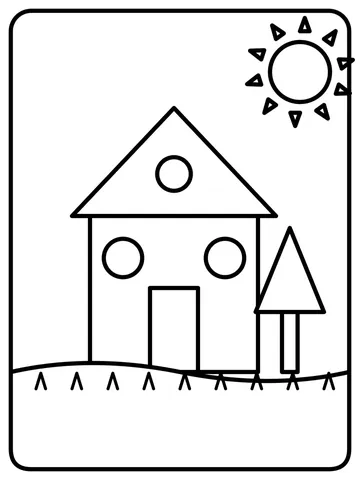
- A house is a square with a triangle roof and rectangle door.
- A car is a long rectangle with two circle wheels.
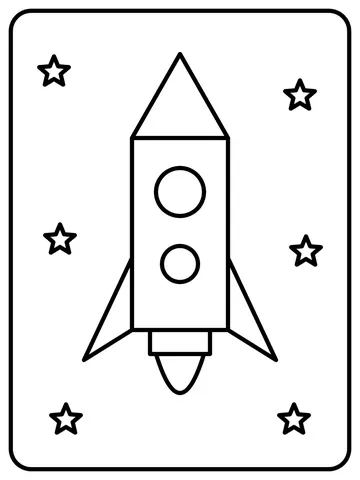
- A rocket is a tall rectangle with a triangle top and fins.
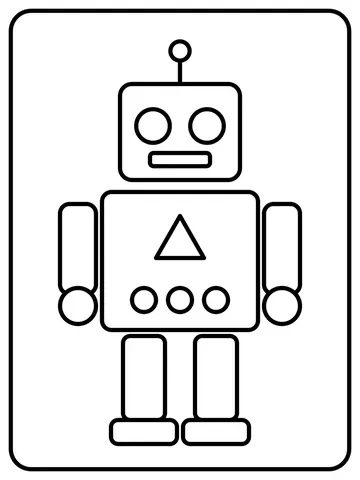
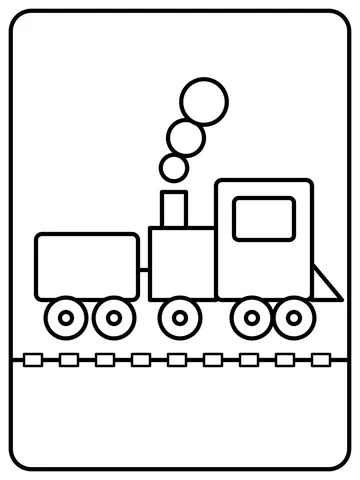
Our shape coloring pages show pictures made from shapes, such as a shape robot and a shape rocket. They are great for spotting shapes before drawing.
Easy step-by-step drawing ideas
Draw these alongside your child, one step at a time.
- Sun: a circle with lines all around and a smiling face.
- Flower: a small circle, petals around it, a stem and two leaves.
- Fish: an oval body, a triangle tail, an eye and wavy scales.
- Snowman: three circles of different sizes, a hat, buttons and stick arms.
- House: a square, a triangle roof, a door, windows and a chimney.
- Owl: a big oval, two big circle eyes, a small triangle beak and wings.
- Butterfly: a long oval body, four wings shaped like loops and curly antennae.
- Dinosaur: an oval body, a long curvy neck and tail, legs and spikes.
- Rainbow: arches in order, then clouds at both ends.
- Star: start at the top, go down to the left, up to the right, across, down and back to the top.
After drawing, compare with a coloring page of the same thing, such as the dinosaur pages or butterfly pages, and notice the details.
Drawing ideas for kids
When children say "I don't know what to draw", offer a prompt:
- Your family as animals
- A house for a monster
- What you did on the weekend
- Your dream bedroom
- A robot that helps with chores
- A new kind of fruit
- An underwater city
- A map of your street
- A self-portrait in a mirror
- A pet you would love to have
Drawing games
Games take the pressure off and make drawing feel like play.
- Squiggle game. One person draws a squiggle; the other turns it into a picture.
- Draw it blind. Draw an object without looking at the paper. The results are funny and the skill is real.
- Finish the picture. Draw half a face or an animal and let your child complete it.
- Pass the paper. Each person draws one part of a creature and folds the paper before passing it on.
- Shape challenge. Roll a dice; each number is a shape to include in the drawing.
How to teach art to kids
Talk about the process, not the result
Instead of "that's beautiful", try "tell me about your drawing" or "I like the way you made the sky so stormy". This helps children think and talk about their choices.
Draw from life
Set up a simple still life, such as a fruit bowl, a toy or a plant, and draw what you see. Observational drawing builds real skill.
Copy and learn
Copying is how many artists learn. Let children copy pictures they like, then change something to make it their own.
Try different tools
Pencils, crayons, markers, chalk, charcoal and paint all feel different. Changing tools keeps drawing fresh.
Keep a sketchbook
A sketchbook shows progress over time. Date each drawing and look back every few months.
Drawing and handwriting
Drawing lines, circles and zigzags is excellent practice for writing letters. Our tracing worksheets and handwriting worksheets build the same pencil control. For more creative projects, see arts and crafts for kids.
Setting up a drawing space
A small drawing space encourages children to draw on their own. Keep paper, pencils, crayons and an eraser in a box at child height, near a table with good light. Add a few picture books or photos for inspiration, and a clipboard for drawing outside. Rotate in new tools every few weeks: chalk one week, watercolor pencils the next. When drawing materials are easy to reach, children will pick them up whenever an idea strikes.
Drawing every day
Short, regular practice beats long sessions. Five or ten minutes a day, such as drawing what they had for breakfast or a quick sketch before bed, builds skills quickly.
Display drawings proudly on the fridge or a gallery wall, and change them often. Seeing their work valued is one of the best motivators for children to keep drawing.
Frequently asked questions
At what age can kids start drawing?
Children start scribbling as early as 12 to 18 months. Simple shapes usually appear around age three, and recognizable pictures around ages four to five.
How do I help a child who says they can't draw?
Start with shapes, draw alongside them, play drawing games and praise effort. Remind them that every artist practises, and that their drawings do not need to look perfect.
Is coloring good for learning to draw?
Yes. Coloring builds pencil control and attention to detail, and looking at how pictures are made from lines and shapes helps children draw their own.